Why Digital Transformation Still Fails and How CCTS Global Delivers Real Outcomes
  • December 30, 2025

Why Digital Transformation Still Falls Short

By 2025, digital transformation is no longer about ambition. Most organizations already operate
cloud platforms, data ecosystems, automation tools, and AI pilots. Yet despite sustained investment,
many transformation initiatives continue to underperform.

The Challenge Is No Longer Technology

Platforms, tools, and roadmaps are already in place. The real barrier to success lies elsewhere —
in how transformation is executed, prioritised, and delivered across the organisation.

⚠️

The Real Issue Is Execution

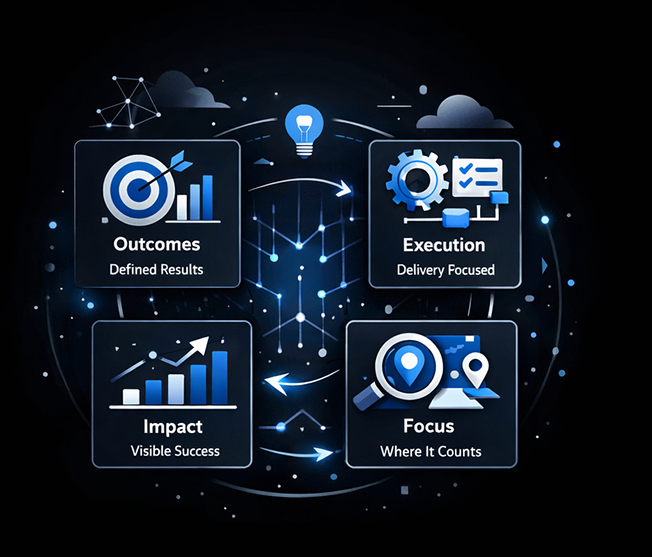
Transformation fails when execution lacks clarity, focus, and alignment to real business outcomes.

The gap between strategy and real-world impact
Where Digital Transformation Breaks Down

Many digital transformation initiatives fail not because of poor intent, but because they struggle to move from strategy into sustained operational change. Organizations invest heavily in plans, platforms, and architectures, yet the expected business value remains elusive. Execution slows, focus shifts, and transformation becomes an ongoing initiative rather than a delivered outcome.

Strategy Without Operational Precision

Technologies such as automation, analytics, and AI are often deployed broadly rather than with intent. Without clearly defining which processes, decisions, or outcomes must improve, solutions go live with fragmented impact that is difficult to measure, scale, or sustain.

Completion Mistaken for Success

Transformation efforts are frequently declared complete when platforms are implemented or workflows automated. However, without success metrics tied to real business outcomes—such as reduced cycle time, lower risk, or faster decisions—activity replaces impact and value remains unrealized.

Poor Adoption and Workflow Misalignment

Even well-engineered solutions fail when they do not align with how teams actually work. When delivery teams are disconnected from end users, systems are underutilized, manual workarounds return, and organizations gradually revert to legacy processes.

How CCTS Global Approaches Transformation Differently

CCTS Global addresses these challenges by operating as a delivery partner with a strong consulting foundation—bringing structured thinking directly into execution. We do not stop at recommendations. We design, deliver, and operationalize solutions that work in the real world.

Our approach is grounded in a simple principle:

Transformation only matters if it changes outcomes on the ground.

We align initiatives with tangible business needs—operational, financial, or risk-related—focusing on delivery from day one. Technology choices are guided by delivery realities, not the other way around. CCTS helps prioritize areas where transformation will have the most immediate and measurable impact, ensuring resources are invested where they matter most.

Outcome-Driven Delivery, By Design

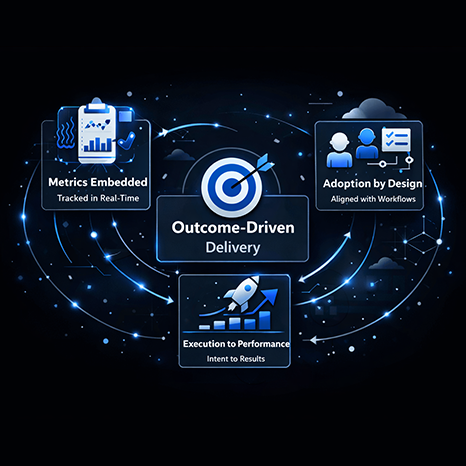
At CCTS, delivery is outcome-led by default, with success metrics embedded from day one, ensuring visible progress and tangible value. Solutions are designed for seamless adoption, fitting how teams work to drive sustained usage beyond go-live. In 2025, organizations need partners who turn intent into execution and measurable performance. CCTS bridges that gap, delivering digital transformation that creates lasting value.

Digital transformation succeeds when execution is clear, focused, and outcome-driven.

CCTS Global partners with organizations to go beyond plans and pilots, delivering solutions that drive real business impact. By focusing on what matters most, we turn transformation intent into sustained performance, ensuring measurable results.

Connect With Us

Simplify your processes. Accelerate your transformation.

At CCTS Global, we help enterprises modernize processes, integrate AI, and scale their Low-Code / No-Code ecosystems — creating digital workflows that are intuitive, intelligent, and enterprise-ready.

Book Consultation

our Articles
View More