Core Requirement
Enable a Nintex Automation K2 application to be accessed through two distinct URLs, while operating on:
-
A single K2 runtime
-
One centralized workflow engine
-
One shared database
Enterprise low-code platforms play a critical role in delivering secure, scalable, and business-critical applications. Organizations depend on these platforms to accelerate solution delivery, reduce development complexity, and maintain strong governance—while seamlessly serving both internal and external users.
Modern enterprises rely on low-code platforms to deliver applications faster while maintaining consistency, security, and compliance. These platforms bridge the gap between business agility and IT governance, enabling organizations to scale digital initiatives without sacrificing control.
Nintex Automation K2 is built for enterprises that require secure, governed, and scalable workflow automation.
A centralized workflow runtime
Role-based security controls
Enterprise authentication integration
Built-in audit and reporting capabilities
K2 is ideal for scenarios where business users and administrators need different access paths while operating on the same application and data, making it a strong fit for multi-URL, single-runtime architectures.
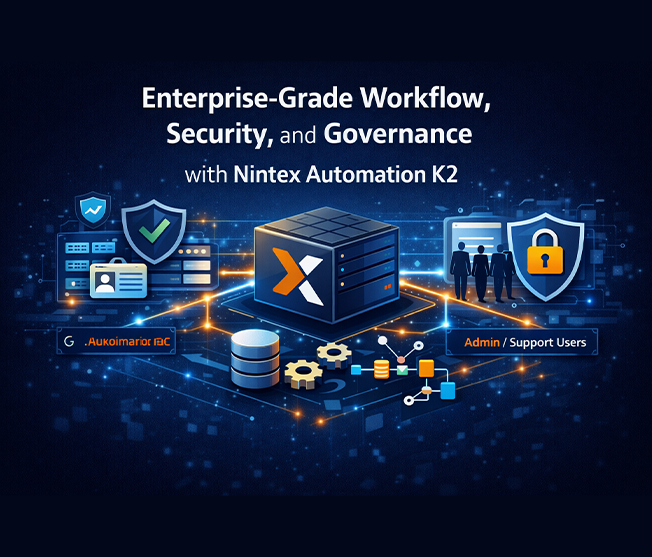
Enable a Nintex Automation K2 application to be accessed through two distinct URLs, while operating on:
A single K2 runtime
One centralized workflow engine
One shared database
A single application supports distinct user groups through separate access paths while sharing the same backend.
Business users access the system via an internet-facing URL for day-to-day operational tasks, secured with MFA and restricted from admin functions.
Admin and support users access the system through a restricted internal URL to manage configurations, master data, and audit logs.
Access paths are fully isolated, ensuring strong separation of duties with a single source of truth.
Single K2 environment only
No duplicate or mirrored databases
No additional licensing overhead
Strong network-level and application-level security
This model is common in banking, insurance, government, and large enterprises, where strict separation of duties is mandatory.
Higher infrastructure and licensing costs
Data synchronization complexity
Complicated deployments and upgrades
Increased operational and support risk
Maintain one K2 runtime
Introduce controlled access entry points
Enforce segregation through network controls, URL-based access, and role-based authorization
Both business and admin users access the same K2 App & Web Server, while entering the environment through separate network paths.
Business User URL: Internet-facing access used exclusively by business users
Admin / Support URL: Internal-only access reserved for platform administrators and support teams
This approach ensures access segregation without duplicating the runtime or data.
Business users access the application through an external URL routed via a DMZ reverse proxy, authenticate, and perform workflow actions such as submissions and approvals. All data is stored centrally, files are securely archived, and administrative access is completely restricted.
Admin and support users access the application through an internal URL over secure network paths, authenticate with elevated roles, and manage dashboards, master data, audit trails, and platform support functions.
Both user flows operate on the same workflows and database, ensuring a single, consistent source of truth.
CCTS Global helps organizations unlock the full potential of Nintex Automation K2 by delivering secure, scalable,
and enterprise-ready solutions. From multi-URL, single-runtime architectures to role-based access segregation
and DMZ integrations, we design solutions that balance security, performance, and governance.